BLUETTI AC200L vs. Jackery Explorer 2000 v2 vs. EcoFlow DELTA 2 Max for RV Travel
The useful differences appear when the power station has to be lifted into a storage bay, recharged from portable solar panels, expanded for longer stays or connected to an RV.
Specifications at a glance
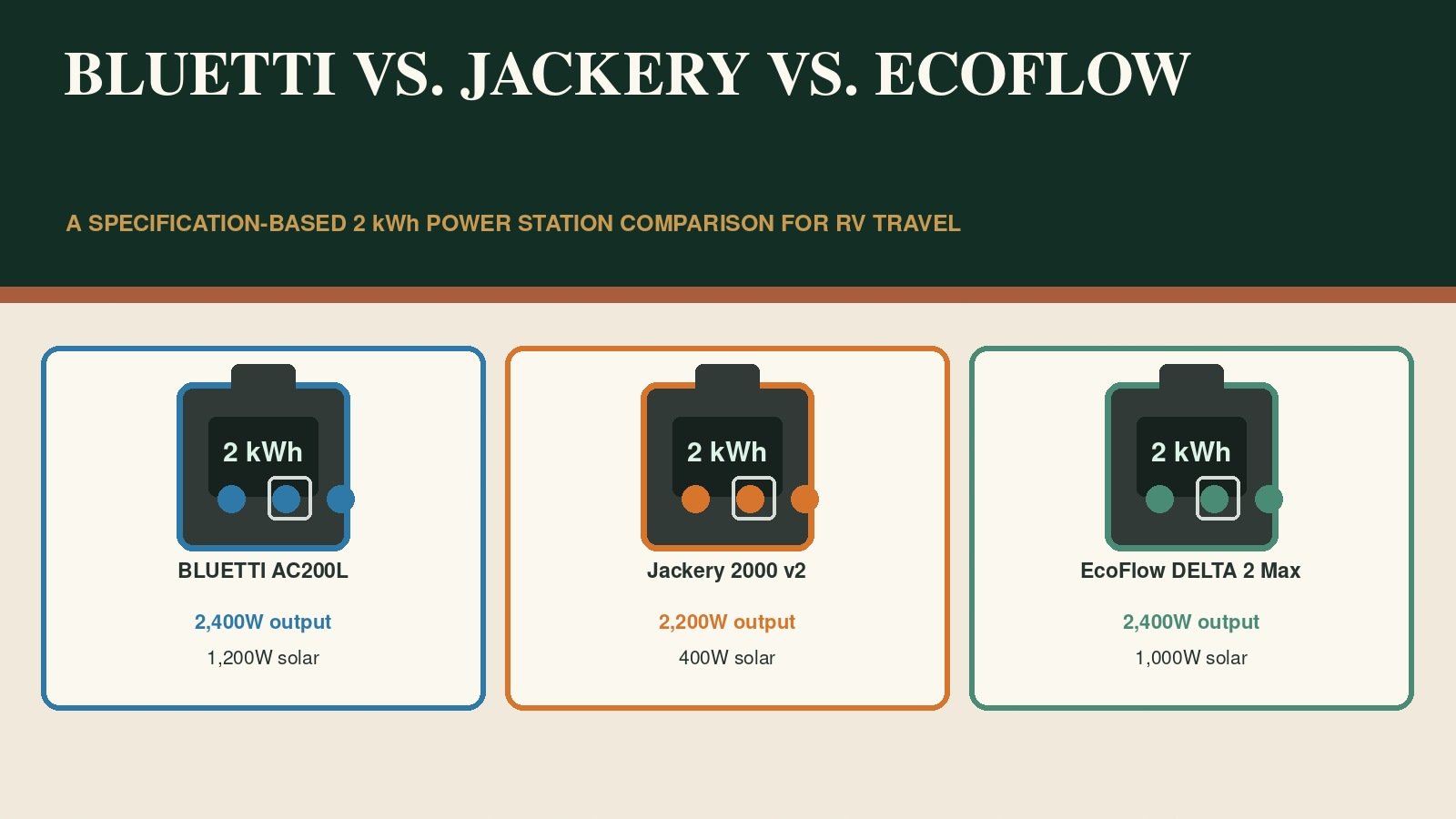
| Specification | BLUETTI AC200L | Jackery Explorer 2000 v2 | EcoFlow DELTA 2 Max |
|---|---|---|---|
| Battery capacity | 2,048Wh | 2,042Wh | 2,048Wh |
| Battery chemistry | LiFePO4 | LiFePO4 | LiFePO4 |
| Rated AC output | 2,400W | 2,200W | 2,400W |
| Maximum solar input | 1,200W | 400W | 1,000W |
| Expansion | Up to 8,192Wh with compatible batteries | Not expandable | Up to 6,144Wh with two compatible batteries |
| Approximate weight | 62.4 lb | About 39 lb | 50 lb |
| Dedicated RV-style outlet | Yes, TT-30 | No | No |
| Published cycle-life claim | 3,000+ cycles to 80% | 4,000 cycles to 70% | 3,000 cycles to 80% |
| Published warranty | 5 years | 3 years plus 2-year extension* | 5 years |
*Confirm Jackery’s current registration or warranty-extension requirements before purchase. Specifications, compatibility and warranty terms can change, so verify the current U.S. product page.
Capacity is effectively a tie
The six-watt-hour difference between 2,042Wh and 2,048Wh is too small to guide this decision. All three store essentially the same nominal amount of energy. Actual AC runtime depends on inverter losses, operating temperature, load behavior, battery state and the power station’s own consumption.
A reasonable estimate begins with:
Estimated runtime = usable watt-hours ÷ average load in watts
“Usable” is deliberately different from the capacity printed on the case. Runtime can vary too widely to promise that any of these units will run an RV refrigerator, furnace, microwave or air conditioner for a particular number of hours.
The Jackery makes portability the clearest priority
At roughly 39 pounds, the Jackery Explorer 2000 v2 is about 11 pounds lighter than the EcoFlow and more than 20 pounds lighter than the BLUETTI. That difference matters when the unit must be moved between the truck, camper, house and picnic table.
The tradeoff is a 400W maximum solar input and no expansion-battery connection. Four hundred watts is still useful for camping, but it places a lower ceiling on how quickly a depleted 2kWh battery can recover from portable panels under good conditions. This is the simplest of the three choices: relatively light, fixed capacity and fewer decisions about future add-ons.
The BLUETTI favors solar input and expansion
The BLUETTI AC200L accepts up to 1,200W of solar input and supports compatible expansion batteries. Its published maximum configuration reaches 8,192Wh, depending on the battery combination. It also includes a TT-30 outlet shaped for a standard 30-amp RV connection.
That outlet deserves an important footnote: the AC200L remains a 2,400W, 120V power station. A TT-30 receptacle does not turn it into a 3,600W campground pedestal. The RV’s combined loads must stay within the power station’s rated output, and high-demand appliances can consume a 2kWh battery quickly.
The cost of this capability is physical. At 62.4 pounds, the BLUETTI is the least convenient of the three to move frequently. It fits better when high solar input, an RV-style connection or later battery expansion matters more than carrying weight.
The EcoFlow occupies the middle ground
The EcoFlow DELTA 2 Max matches the BLUETTI’s 2,400W rated output while weighing about 50 pounds. It accepts up to 1,000W of solar and can reach 6,144Wh with two compatible DELTA 2 Max Smart Extra Batteries.
It does not provide a TT-30 outlet, but it offers six standard AC receptacles plus USB and 12V outputs. For someone who wants meaningful solar input and expansion without moving the heaviest unit, the EcoFlow creates a practical middle option.
Do not compare boost-mode numbers as continuous output
Manufacturers use names such as Power Lifting and X-Boost for modes that may operate certain resistive loads above the ordinary rated output. Those numbers are not equivalent to continuous inverter output, and not every appliance will tolerate the altered voltage behavior involved.
The most useful comparison is the published continuous rating: 2,400W for BLUETTI, 2,200W for Jackery and 2,400W for EcoFlow.
Solar input may matter more than fast wall charging
All three promote rapid charging from an AC wall outlet. At a campsite with shore power, however, wall-charging speed may be less important than recovery away from hookups. The solar-input ceiling is where the products separate sharply: 400W for Jackery, 1,000W for EcoFlow and 1,200W for BLUETTI.
The rating is a maximum input limit, not a promise of real production. Panel wattage, temperature, shading, sun angle, wiring and voltage compatibility all affect charging. Confirm that the panel array remains inside the power station’s published voltage, current and wattage limits.
Which design fits which RV priority?
- Choose by carrying weight: The Jackery is the clear specification leader when frequent lifting and compact transport matter most.
- Choose by solar and expansion: The BLUETTI provides the highest solar-input limit, broadest published expansion and a TT-30 RV outlet.
- Choose a middle ground: The EcoFlow combines 1,000W solar input, expansion to 6,144Wh and lower weight than the BLUETTI.
What specifications do not tell you
Specifications do not reveal long-term reliability, customer-service quality, app performance under poor connectivity, fan noise in a sleeping area, real inverter efficiency or how easily a unit fits a particular storage bay. Those details are better evaluated through hands-on testing and long-term owner reports.
Before buying, measure the intended storage location, list the appliances and their starting demands, decide how the unit will recharge, and confirm the current manual, included cables, outlet configuration, expansion-battery compatibility and warranty terms.
A 2kWh label tells how much energy is stored. It does not decide whether the box belongs in your camper.
Safety note: Follow the current power-station manual and the RV manufacturer’s instructions. Confirm input limits, ventilation, grounding and neutral-bonding requirements, load ratings, cable capacity and storage-temperature limits. A portable power station is not a substitute for safe shore-power equipment or qualified electrical help.