
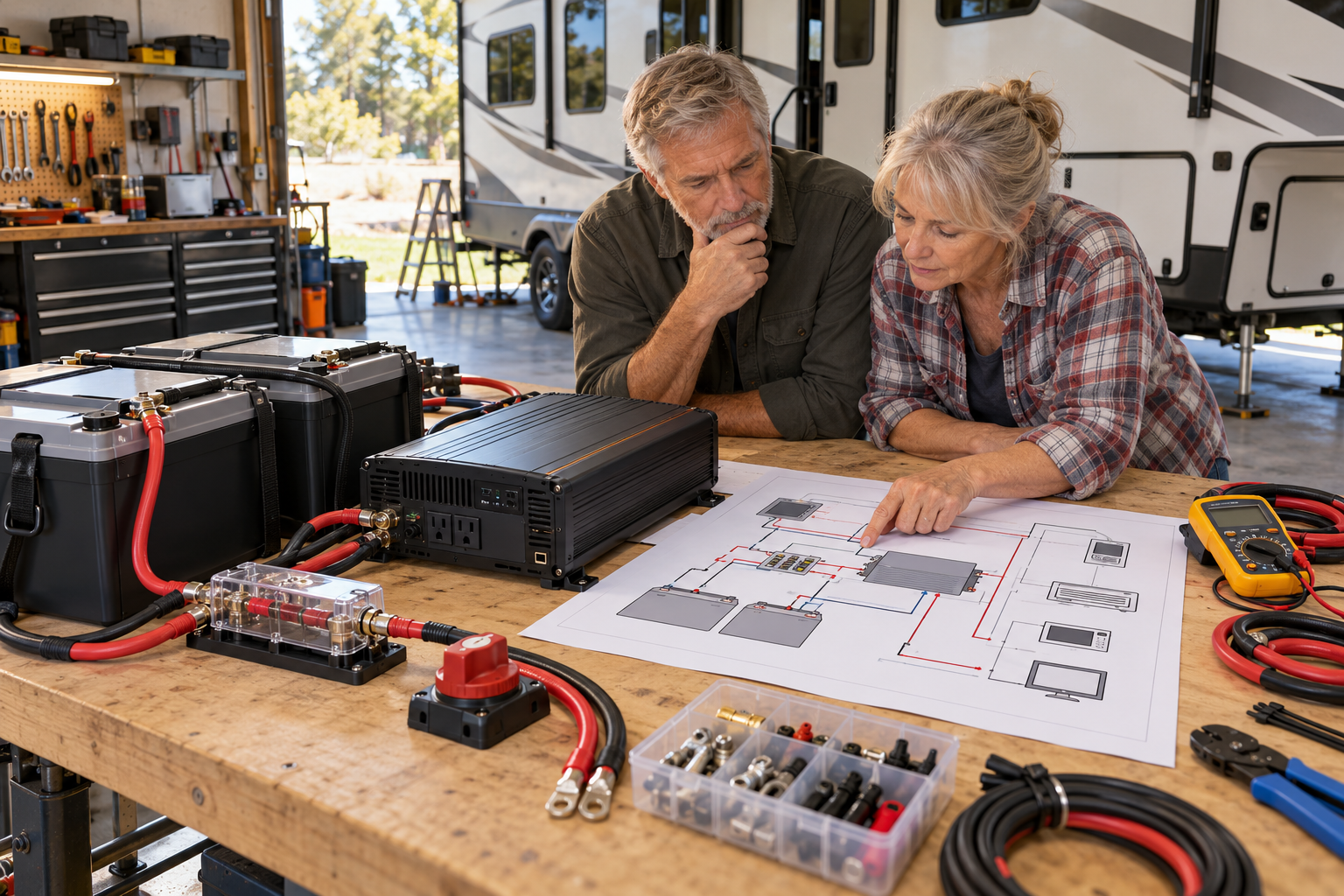
Choosing an RV Inverter: Pure Sine Wave, Surge, and 12V vs. 24V
Part 6 of 8 in the RV Solar Planning Series.
An inverter should be chosen from a load plan, not from the largest number that fits the budget. Oversizing can increase idle consumption and cost; undersizing can trip on ordinary combinations of appliances.
Add the loads that truly run together
List the continuous watts for realistic simultaneous use, then check manufacturer surge requirements for motors, compressors and transformers. The inverter’s continuous rating, surge duration and output waveform all matter.
Use a pure sine wave inverter for a new RV system. It provides the appropriate waveform for sensitive electronics and motor-driven equipment without gambling on whether a modified waveform happens to behave acceptably.
Carry the calculation back to DC
A 2,000-watt AC load requires more than 2,000 watts from the battery because the inverter is not perfectly efficient. At a lower battery voltage, the same power requires more current. That current has to remain within the BMS, conductor, connection, fuse, busbar and disconnect ratings.
Know when 12 volts is the simpler answer
Most RV house equipment is built around nominal 12 volts. For modest inverter loads and short well-designed cable runs, a 12-volt battery bank may keep the architecture straightforward.
Know what 24 volts changes
At the same power, doubling nominal voltage roughly halves current. That can make substantial inverter loads easier to manage. It does not eliminate the RV’s 12-volt needs. A 24-volt system normally requires a properly sized 24-to-12 converter or another engineered method to supply jacks, slides, lights, pumps, fans and control boards. Do not tap the midpoint of a series battery bank to obtain 12 volts; that creates imbalance.
Keep 48 volts outside a beginner RV plan
A nominal 48-volt lithium bank operates above the familiar extra-low-voltage range at some states of charge and brings additional shock, component and service considerations. OSHA materials use 50 volts as a widely recognized electrical-safety threshold. For this beginner planning series, 48-volt architecture is outside scope and belongs with qualified design.
The inverter and system-voltage pages in the Gram & Pap RV Solar Planning and Setup Guide compare simultaneous loads, surge, idle draw, BMS current and the 12-volt support required by a 24-volt bank.
Choose an architecture, not a box
The inverter, bank voltage and DC distribution are one decision. If changing one number forces the rest of the system into exceptions, the plan needs another pass before the cables are cut.
Safety note: This article is a planning aid. RV electrical systems and equipment requirements vary. Follow current manufacturer manuals and applicable codes, and use a qualified RV electrician when the work or requirements are uncertain.