How to Plan RV Travel Days, Fuel Stops, and Campground Reservations
A map can tell you that the campground is 300 miles away. It cannot tell you how long it will take to maneuver through a crowded fuel stop, whether lunch will become an hour, or how cheerful either traveler will be after backing into a campsite in the dark.
RV route planning works better when you stop thinking only about the line from home to destination and start planning the individual travel days that make up the trip.
Choose the fixed points first
Begin with the dates and places that cannot move. That might be a reserved national-park site, a family gathering or a campground with a firm arrival window. Put those anchors on the calendar before filling the spaces between them.
Next, identify the first and last travel days. Departure days often start later than imagined, and the final day may include unloading after you get home. Giving those days honest expectations keeps the whole route from becoming too ambitious.
Plan each leg as its own job
For every travel leg, record:
- Starting point and destination
- Estimated mileage
- Realistic drive time
- Likely fuel and rest stops
- Road, clearance, grade or weather notes
- The campground’s arrival window
Navigation time is only the base. Add time for fuel, food, restrooms, pets, traffic and the slower pace of towing. If a route only works when everything goes perfectly, it does not work yet.
Choose fuel stops for the rig, not just the price
The cheapest station is not a bargain if the entrance is too tight or the exit points the wrong way. Look at access, pump layout and the road you need afterward. Satellite images and recent traveler reviews can help, but always use current conditions and your own judgment.
Do not plan to arrive on fumes. Range changes with speed, terrain, wind, temperature and load. A comfortable reserve gives you choices when a planned stop is crowded, closed or awkward.
Record campground details while they are in front of you
Once a reservation is complete, capture the useful details immediately:
- Campground name and phone number
- Dates and site number
- Confirmation number and price
- Electric service, water and sewer
- Pull-through or back-in site
- Check-in time, gate instructions and arrival notes
That is much easier than searching email while parked near the office with a trailer behind you and three vehicles waiting to get around.
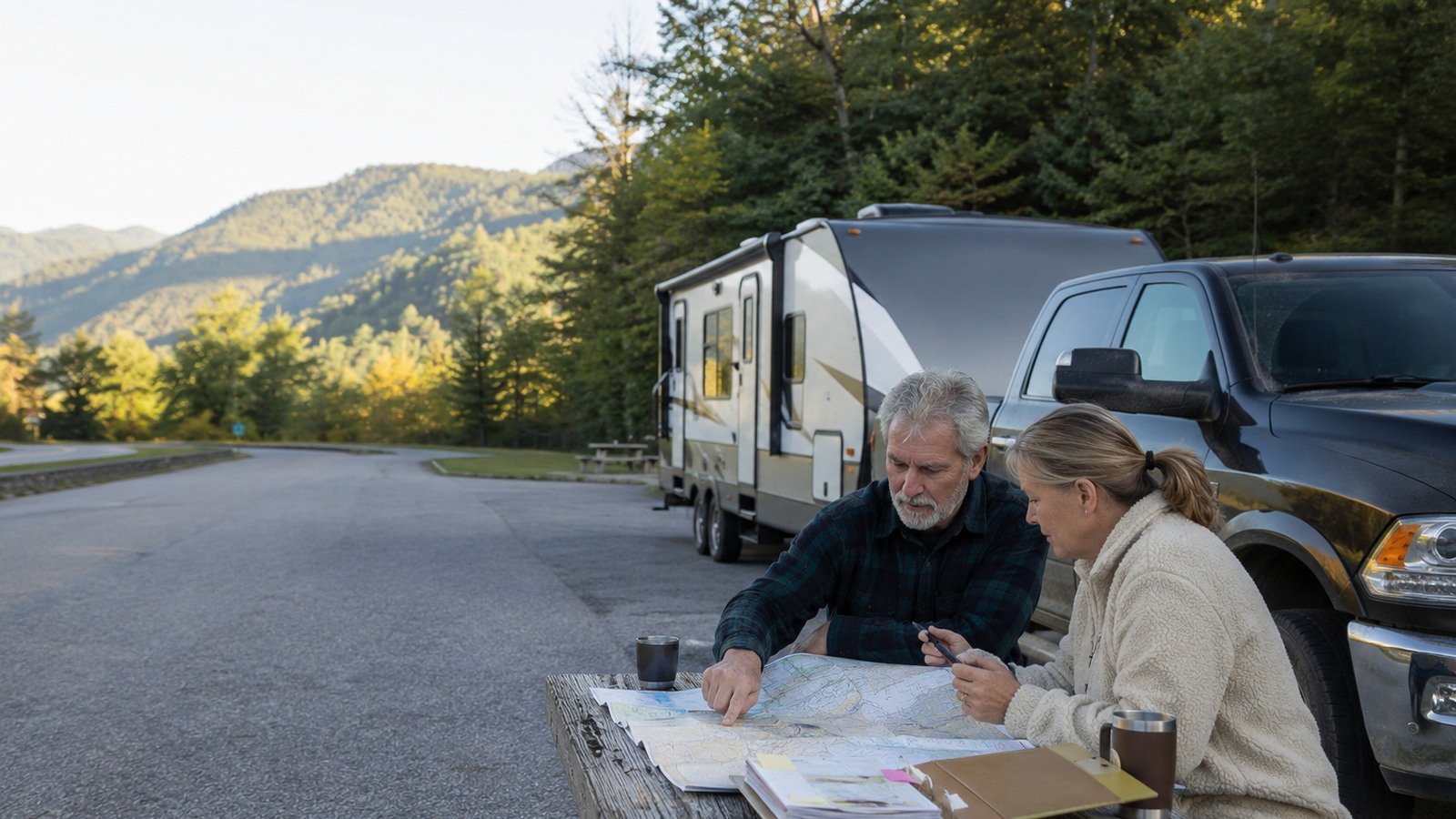
Keep route planning and reservations side by side
A route and a campground are connected decisions. A beautiful campground is not a good overnight stop if reaching it requires a travel day nobody wants to repeat.
The coordinated Route & Stops and Campground Reservations pages in the printable Gram & Pap RV Trip Planner are designed to keep those decisions together. Use RV-specific navigation to select safe roads, then record the chosen legs, stops and reservation information where both travelers can see them.
Make one backup before leaving
You do not need an alternate itinerary for every possibility. You do need to know what you will do if the main route closes, the weather turns or you cannot reach the campground before its office closes.
Write down an alternate road or safe stopping area, and save the campground phone number where it is easy to reach. Download essential maps before entering areas with uncertain service.
Protect the arrival
The last hour deserves as much thought as the first. Check the campground approach, not just its address. Read current arrival instructions. Know whether the office closes, the gate requires a code or the final road discourages late arrivals.
A good travel day ends with enough daylight and patience left to set up properly. The point is not to cover the most miles. The point is to arrive ready to enjoy the place you worked so hard to reach.