Death Valley Hidden Gems: RV Routes Beyond Tourist Crowds
Picture this: we’re sitting in our camp chairs at sunset, cold drinks in hand, watching the last light paint the Panamint Mountains gold. Not another soul in sight. No tour buses rumbling past, no crowds jockeying for the perfect photo. Just us, our RV, and the vast silence of Death Valley hidden gems that most folks never discover.
After three weeks exploring Death Valley National Park, we learned something important: the popular spots are popular for good reason, but the real magic happens when you venture beyond the main roads. Those washboard backcountry routes that make your teeth rattle? They lead to some of the most spectacular boondocking spots and viewpoints we’ve found in our years of RV life.
Finding Death Valley Hidden Gems: Our Route Discovery
The ranger at Furnace Creek Visitor Center gave us the first clue. “Most RVers stick to Badwater and Zabriskie Point,” she said with a knowing smile. “But if you don’t mind some rough roads, there’s so much more to see.”
She was right. Armed with our trusty road atlas and a healthy sense of adventure, we started exploring the network of dirt and gravel roads that spider web through the park. Some require high clearance vehicles, others are perfectly manageable for our 30-foot motorhome – you just need to know which ones to attempt.
The key is talking to rangers, checking road conditions, and always carrying extra water. Death Valley doesn’t forgive mistakes, but it rewards the prepared with experiences that’ll stick with you forever.
Essential Planning for Backcountry RV Routes
Before we dive into specific locations, let’s talk preparation. Death Valley’s backcountry isn’t like cruising through a KOA campground. We learned to check the park’s road condition reports religiously – what’s passable today might be washed out tomorrow after a flash flood.
Our basic kit included: extra water (we carried 10 gallons beyond our tank capacity), a satellite communicator for emergencies, paper maps as backup to GPS, and a good shovel. The shovel came in handy twice when we had to clear small rock slides from narrow passages.
Most importantly, we told someone our plans. The park rangers appreciate knowing when RVers are heading into remote areas, and honestly, it gave us peace of mind too.
Hidden Gem #1: Titus Canyon’s Secret Viewpoints
Everyone knows about the main Titus Canyon Road – it’s one-way from the Nevada side and ends near the visitor center. But here’s what most miss: there are several unmarked pullouts along the route that offer incredible valley views without the crowds at the official overlooks.
We discovered our favorite spot about halfway through the canyon. A small clearing just big enough for our rig provided a perfect overnight stop with panoramic views of the Grapevine Mountains. No facilities, no neighbors – just pure desert solitude.
The road itself tells a story. As we wound through the narrow canyon walls, we could see layers of geological time in the rock formations. Ancient lake beds, volcanic activity, and millions of years of erosion painted in stone. It’s like driving through an outdoor geology museum.
Camping at Titus Canyon
Finding level ground can be challenging, but the effort pays off. We spent two nights at our secret spot, watching the canyon walls change color as the sun moved across the sky. Mornings were particularly magical – the rock faces glowed pink and orange in the early light.
The silence was profound. After weeks of generator-powered campgrounds, the absolute quiet of the desert night was almost overwhelming. We could hear our own heartbeats, the settling sounds of our RV cooling down, and absolutely nothing else.
Hidden Gem #2: Artist’s Palette Alternative Routes
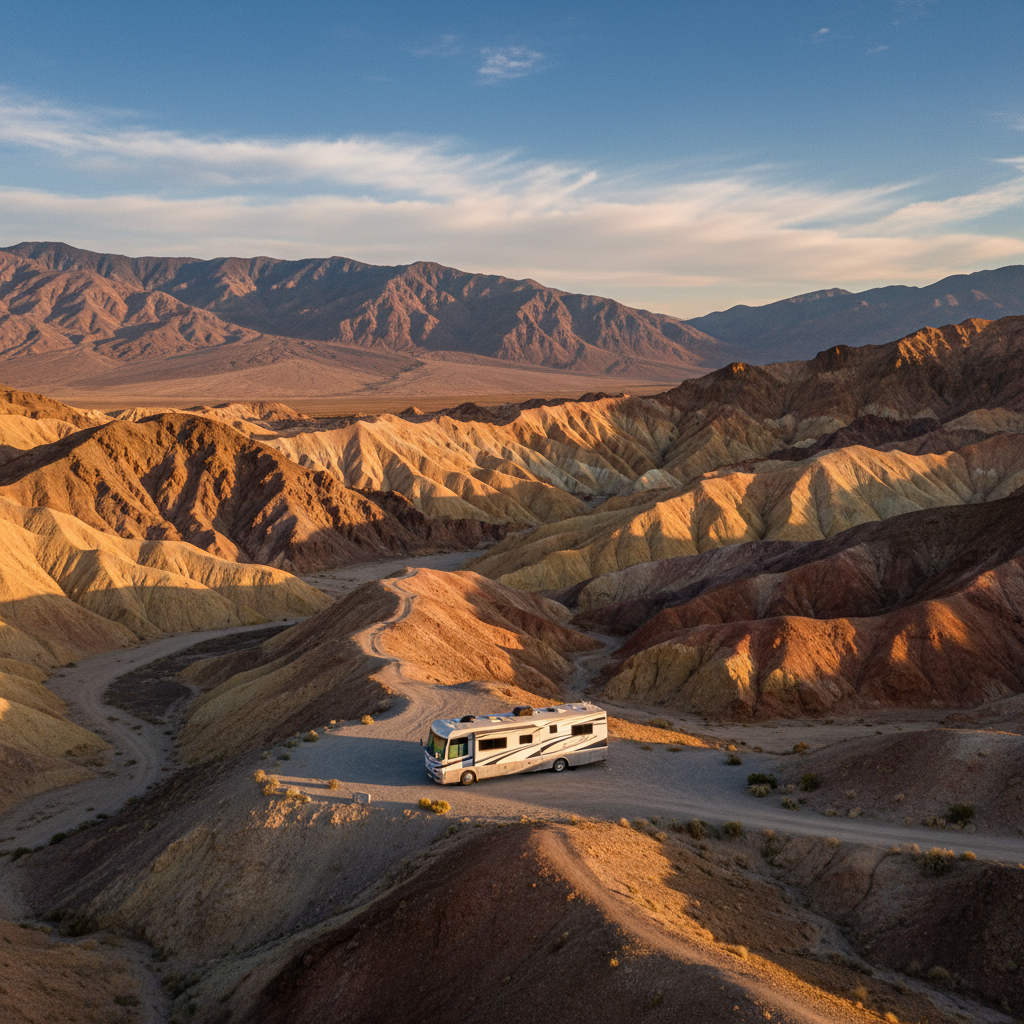
Artist’s Drive gets all the attention, and deservedly so. But we found equally stunning mineral-painted hills by taking the lesser-known routes that branch off the main scenic drive. These Death Valley hidden gems offer better photography opportunities and, more importantly for RVers, room to actually stop and set up camp nearby.
One unmarked road led us to a cluster of multicolored badlands that rivals the famous Artist’s Palette. The difference? We had it entirely to ourselves for three days. No tour groups, no time pressure – just the freedom to explore at our own pace.
The colors here are incredible. Iron oxide creates the reds and oranges, while copper compounds paint sections green and blue. It’s nature’s chemistry lesson, written large across the landscape.
Photography and Exploration Tips
Early morning and late afternoon provide the best light for capturing the mineral colors. We discovered that overcast days actually enhanced the colors, making them pop without harsh shadows.
For RVers, the key is finding stable ground for your rig while keeping your towed vehicle or motorhome accessible for daily explorations. We found several spots where we could unhook our truck and explore deeper into the colorful hills on foot.
The Ultimate Boondocking Discovery
Our biggest find came completely by accident. Following what looked like a maintenance road on our map, we stumbled onto a plateau overlooking the entire valley floor. The spot was large enough for several RVs but remote enough that we never saw another camper during our four-day stay.
This became our base camp for exploring multiple Death Valley hidden gems. From here, we could day-trip to slot canyons, abandoned mines, and viewpoints that aren’t marked on any tourist map. The boondocking experience here surpassed anything we’d found in Arizona or Nevada.
Water management became crucial. Four days off-grid in the desert heat meant careful rationing and creative conservation methods. We learned to shower every other day and reuse gray water for cleaning tasks.
Solar Power in the Desert
Our solar setup performed beautifully in Death Valley’s intense sunlight. Even in March, we were generating more power than we could use during peak sun hours. The key was keeping panels clean – desert wind carries fine dust that can reduce efficiency by 20% or more.
We developed a routine of wiping panels down every morning with a damp cloth. The extra power allowed us to run our 12V fridge constantly and even use a small fan during the hottest part of the day.
Navigating Washboard Roads: Lessons Learned
Not all of our backcountry explorations went smoothly. Some roads tested our patience and our suspension system. Washboard surfaces are a fact of life when seeking Death Valley hidden gems, but we learned techniques to make the experience more bearable.
Speed matters more than you’d think. Too slow, and you feel every bump. Too fast, and you’ll shake something loose. We found our sweet spot around 15-20 mph on most washboard sections. The RV would settle into a rhythm, floating over the bumps rather than dropping into every pothole.
We also learned to air down our tires slightly on particularly rough sections. Dropping from 80 PSI to 70 PSI made a noticeable difference in ride quality and gave us better traction on loose gravel.
When to Turn Back
Knowing your limits is crucial in the backcountry. We encountered two roads that we decided were beyond our comfort level – one due to steep grades, another because of loose rock that could have damaged our undercarriage.
There’s no shame in turning around. Death Valley will still be there on your next visit, and repairs in the middle of nowhere are expensive and inconvenient. We found plenty of amazing spots without pushing into truly challenging terrain.
Local Culture and Desert Communities
One unexpected joy of exploring Death Valley’s remote areas was meeting the handful of people who actually live and work in this harsh environment. Park maintenance crews, researchers, and long-term camp hosts shared stories and local knowledge that no guidebook contains.
We met Jim, a volunteer camp host who’d been spending winters in Death Valley for fifteen years. He showed us hand-drawn maps marking water sources, cell service areas, and the best spots for different types of RVs. This kind of local knowledge is invaluable for finding true Death Valley hidden gems.
The desert mining history also came alive through these encounters. We explored several abandoned mine sites, always respectfully and safely, learning about the boom-and-bust cycles that shaped this landscape.
Respecting the Desert Environment
Leave No Trace principles are especially important in desert environments. We packed out everything, including gray water when camping in sensitive areas. The desert ecosystem is fragile – a tire track can last decades, and disturbed vegetation may never recover.
We also learned to appreciate the desert’s subtle beauty. At first glance, Death Valley can seem barren and lifeless. But spend time quietly observing, and you’ll spot lizards, birds, and hardy plants that have adapted to this extreme environment.
Planning Your Own Hidden Gem Adventure
So how do you find these Death Valley hidden gems for your own RV adventure? Start with the park rangers – they’re incredibly knowledgeable about current road conditions and can recommend routes suitable for your specific rig.
The best time for backcountry exploration is October through March. Summer temperatures make remote camping dangerous, and spring can bring flash flood conditions that close backcountry roads.
Consider your RV’s capabilities honestly. Our 30-foot Class A handled most dirt roads fine, but we avoided narrow canyons and steep grades. Smaller rigs have access to more remote areas, while larger RVs are more comfortable for extended boondocking.
Essential Apps and Resources
We relied on several tools for navigation and planning. The National Park Service app provided offline maps and current road conditions. iOverlander helped us find potential camping spots marked by previous RVers.
Paper maps remain essential backup. GPS signals can be spotty in canyons, and electronic devices can fail. We always carried current topographic maps and knew how to use them.
Why These Hidden Routes Are Worth the Drive
After three weeks exploring Death Valley’s backcountry, we understood why this place captures people’s imaginations so completely. Yes, the popular spots are spectacular – Badwater Basin’s salt flats and Zabriskie Point’s sunrise views deserve their fame.
But the Death Valley hidden gems we discovered offered something more precious: solitude and discovery. There’s something profoundly satisfying about finding a perfect campspot that isn’t listed in any guidebook, or watching sunset paint canyon walls from a viewpoint you have entirely to yourself.
The desert changed us in subtle ways. Stripped of distractions, we rediscovered the simple pleasure of sitting quietly and observing. The night sky, unpolluted by artificial light, reminded us how small we are in the cosmic scheme.
These hidden routes aren’t just about reaching destinations – they’re about the journey itself. Every mile of washboard road, every careful navigation decision, every moment of uncertainty followed by relief when you find the perfect spot. That’s the real magic of RV life in Death Valley’s backcountry.
We left with full memory cards, empty water tanks, and hearts full of desert magic. The crowds and tour buses serve their purpose, introducing people to Death Valley’s wonders. But for those willing to venture beyond the paved roads, the park’s true treasures await.
Some experiences can’t be shared on social media or captured in guidebooks. They live in the quiet moments between heartbeats, in the vast silence of desert nights, and in the satisfaction of discovering something beautiful that few others have seen. That’s what Death Valley’s hidden gems offered us, and that’s why every washboard mile was worth the drive.